What it takes to make digital health work for everyone
Overivew
A woman in a remote community is referred from her local clinic to a hospital. She shares a phone with her family, the clinic’s internet connection is unreliable, and travelling to the hospital costs money. A digital health card might help the hospital retrieve her previous records. But first, someone needs to confirm that the hospital can see her, explain the referral in a language she understands, and agree with her privately on how she can be contacted. If she makes the journey and the service is unavailable, the programme needs to know what happened and who will follow up.
That example captures a question I took away from a consultation on Bangladesh’s health sector digital transformation programme supported by the Asian Development Bank (ADB). I joined the discussion on behalf of Women in Digital. Indigenous representatives, civil society organisations and health specialists brought perspectives from community clinics, remote areas, and work with people who experience discrimination when seeking care. The programme was in preparation, and the discussion was intended to inform its Poverty and Social Analysis and Gender Assessment and Action Plan. That timing matters. Decisions about staffing, connectivity, privacy and community participation shape what a pilot can achieve and need a place in its budget.
From our work on digital health passports, I see real value in making important health information available when a patient moves between providers. I would judge the success of that work by whether someone who previously struggled to get care can now receive it safely, with less effort and greater control over their information.
Start with the care people can actually receive
In the consultation, participants asked what happens when a clinic exists on paper but a patient arrives to find no available clinician, medicine or service. They described long journeys, unexpected costs and areas that can be difficult to reach during the rainy season. Others highlighted the potential of a shared record to spare patients from having to recount their history at each facility and help clinicians decide whether previous results are still usable.
Both concerns belong in the design. A referral system can show where patients repeatedly encounter unavailable appointments or services. It takes a health service manager with the authority and resources to act on those findings. The World Health Organization’s guidance on digital interventions asks countries to assess feasibility, harms, cost and equity alongside potential benefits, and stresses that digital tools depend on functioning health services. WHO guideline on digital interventions for health system strengthening
I would start by mapping one or two common journeys in each pilot district. A maternal care referral, for example, can show which services a community clinic provides, which facility accepts referrals, what it costs a patient to travel, and who checks whether the visit happened. Sit with frontline workers and patients as they walk through those steps. If staff currently enter the same information into three systems, account for that workload before adding another form. If patients regularly arrive to find a service unavailable, give the receiving facility a way to confirm capacity before a patient travels.
Build on the systems a country already has
Bangladesh has a published Digital Health Strategy for 2023–2027. Its Directorate General of Health Services describes the use of DHIS2 for collecting and analysing health information and publishes a Bangladesh Core FHIR implementation guide for exchanging health information. The practical design question is how to build on these investments and connect the workflows that need to work across facilities. Bangladesh Digital Health Strategy · DGHS overview of DHIS2 · Bangladesh Core FHIR specification
A national reporting system helps answer questions such as how many people received a service. A clinical record helps an authorised provider understand the history of the person in front of them. A health ID helps match that person to the correct record. A card gives the patient a way to present that identifier. Each has a different job, and the system needs clear rules about how the pieces connect.
Interoperability becomes meaningful when two facilities can exchange and correctly interpret a referral, test result or medication list. For a pilot, I would specify the minimum information each transaction needs, who can send or receive it, and how staff handle an incorrect match, an incomplete record or an unavailable system. Run those tests with the actual software and workflows of participating facilities. If private providers are involved, include their staff in the same tests. Require suppliers to demonstrate standards conformance and usable data export before procurement acceptance. WHO’s SMART Guidelines offer reusable specifications that countries can adapt to local clinical workflows and standards. WHO SMART Guidelines
Design for the person who has the least control over access
A household may own a phone while the person seeking care has limited or monitored access to it. A reminder sent automatically to that phone could reveal a private appointment. An older person or a person with a disability may want a caregiver’s help with transport or reading a message while still wanting to decide what the caregiver can see. A patient may understand their care in a local language that the interface and consent form do not support.
These are decisions the pilot can test. Can a person register with help at a clinic and continue receiving care while an ID problem is resolved? Can they request a phone call, an in-person follow-up or no message to a shared device? Can they change their choice later? Can they use the service with an interpreter or through an accessible interface? Can the facility continue its work during a power or network outage and reconcile records safely afterwards?
The consultation also made clear why each district needs its own plan. Indigenous communities in the Chittagong Hill Tracts and in the plains may face different language, transport and service barriers. Women’s organisations, Indigenous and customary institutions, organisations of persons with disabilities, and hijra- and transgender-led organisations can help define what should be tested and review the results. Pay for their time, travel and interpretation. Give them a route to raise issues throughout implementation and a regular opportunity to see what the programme changed.
Where family members influence access to care, include them in community outreach while protecting the patient’s right to make decisions privately. Give frontline staff practical training with cases they recognise. Ask them to practise helping someone who shares a phone, arranging support for a patient who uses a different language, and handling a situation where a caregiver asks for information the patient wishes to keep private.
Make privacy and accountability part of the service
A health record can contain information about reproductive care, mental health, gender identity or experiences of violence. A person who fears discrimination may avoid care if they believe a family member, employer or anyone outside their care team could gain access to it. A registration screen asking for agreement tells us very little about whether the patient understood the choice or felt free to make it.
I would ask the programme team to explain, in plain language, what is collected, why it is needed, who can see it and how a patient can challenge an error. Collect the minimum data needed for each task. Give staff access based on their role and clinical purpose, record access so it can be reviewed, and rehearse what happens when someone suspects misuse. Where a patient chooses to give a caregiver access, make the scope of that access clear and provide a way to change it. Agree with Indigenous organisations before recording or reusing traditional knowledge, including any proposed use in AI.
People also need somewhere safe to go when things go wrong. A community organisation or drop-in centre could offer a confidential way to report discrimination or suspected misuse without a smartphone. Handle the complaint outside the clinical record, name an official responsible for responding, and give the person a safe way to learn what happened. Review recurring issues with community representatives using information that protects complainants’ identities.
Learn from different national approaches
Countries can share methods while setting their own priorities for service delivery, governance and technology. The examples below illustrate design choices and the questions those choices raise.
Bangladesh. The existing strategy, reporting infrastructure and national interoperability specifications give a programme team concrete foundations to work from. A useful pilot would show whether information can travel from a community clinic to a referral hospital and whether the patient gets help completing that journey. It should also show how the workflow performs when clinic staffing, power and connectivity vary by location. Bangladesh Digital Health Strategy · Bangladesh Core FHIR specification
India. The Ayushman Bharat Digital Mission provides an example of a national health account and an exchange framework designed around consent for sharing records. That raises a question every country should test locally. Can a person understand and exercise that choice if they use a shared device, need assistance, or have difficulty reading the available language? Government of India briefing on digital health records and consent
Tanzania. Tanzania’s Ministry of Health describes using the Health Information Mediator and Muungano Gateway to link major digital platforms. It also reports differences in electronic medical record coverage across levels of care. That distinction matters when designing a referral: a hospital and a smaller facility may have very different capacity to send, receive and act on the same information. Tanzania Ministry of Health report on digital health infrastructure
Ghana. WHO’s Regional Office for Africa describes a national evaluation platform established to track implementation, identify gaps and inform the next phase of Ghana’s digital health strategy. A country planning its first pilot can apply the same principle early by deciding who reviews results, how often they review them and what changes they have authority to make. WHO Africa update on Ghana’s digital health strategy
Give the pilot a budget and a decision to inform
I would organise a pilot around five commitments:
- Choose a care journey and record the starting point. Measure current referral completion, time to care, patient travel and costs, and the amount of work staff spend on recording and follow-up. Ask patients where they get stuck.
- Agree on ownership. Name the health authority responsible for the programme, the district leads who can fix operational problems and the people responsible for data governance and complaints. Give community representatives a funded role in design and review.
- Fund routine operations. Budget for staff time, refresher training, translation, accessible materials, connectivity, backup power where needed, device replacement, technical support and maintenance after the pilot. Test recovery from outages with frontline staff before relying on the system.
- Measure care and access. Track the proportion of referred patients who receive the intended service, time to completion, reasons referrals fail, and whether staff can resolve problems. Review who is missing from the figures using appropriate privacy protections. Combine the numbers with feedback from people who abandoned a referral or never registered.
- Decide what must improve before expanding. Agree in advance on acceptable service, accessibility and privacy performance. Review the evidence with districts and communities. Keep a record of what changed, who owns the remaining problems and when those problems will be reviewed again.
A registration count tells us how many people entered the system. A referral completion rate tells us whether people made it through one part of the care journey. Both matter, and the gap between them is often where the most valuable work lies.
Where a health passport fits
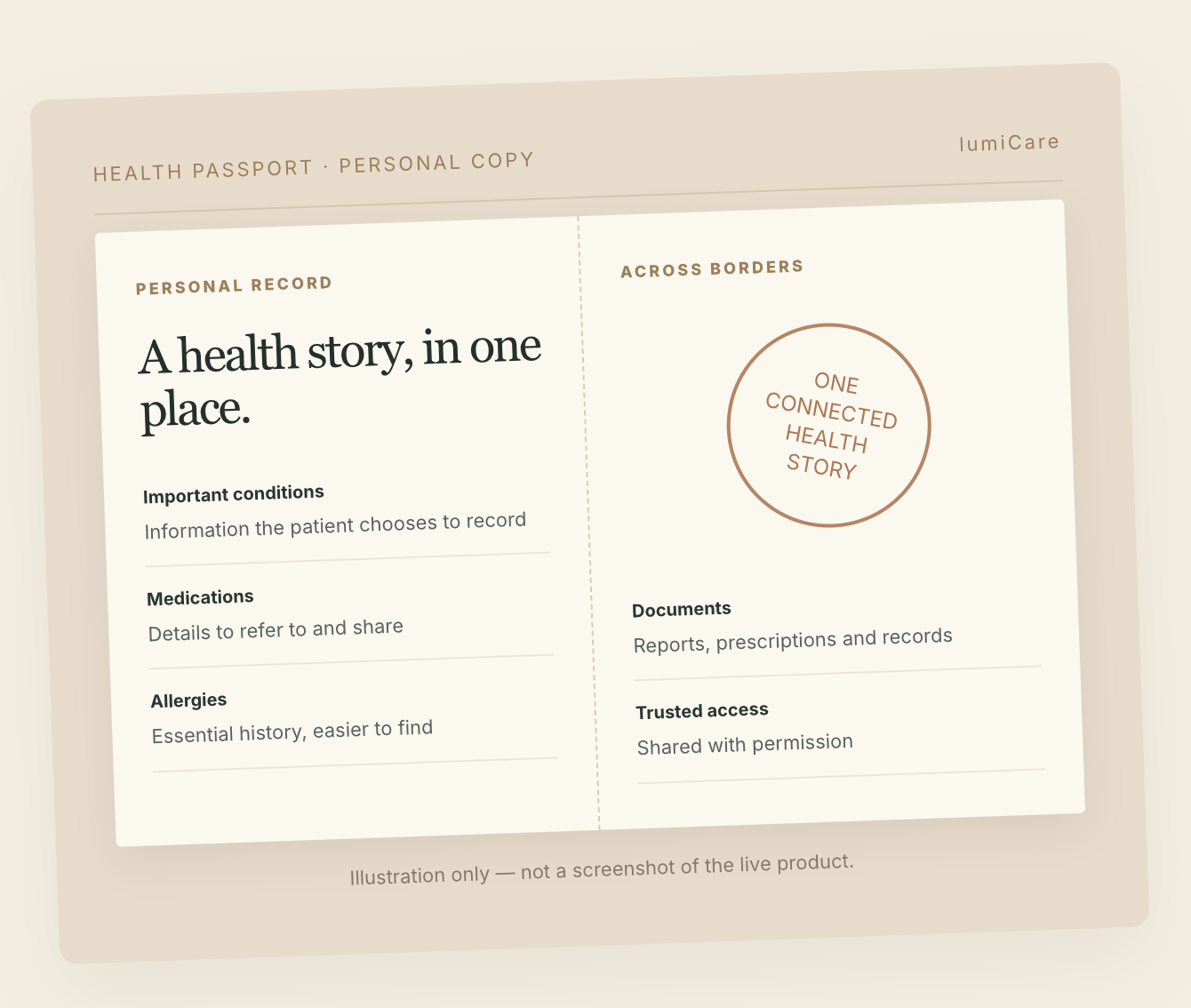
Our work at Women in Digital on a digital health passport has led me to focus on the moment when information needs to move with the patient. Imagine an older adult seeing a new provider who needs to know which medicines they take and which records came from their previous clinic. Or a person carrying a referral from a community facility who wants the hospital to see the relevant history without repeating it in a crowded waiting area.
A passport can give patients a way to present or share selected information. Its design should make clear who supplied each item, when it was updated and what the patient has chosen to share. The underlying records and access rules have to work with the local health system. A card or QR code can help people reach the right record. I would keep sensitive clinical information off the card itself and design assisted access for people without a personal device.
For Women in Digital, the next question in any health passport project is the same one I would ask a national programme. Can someone use it at the moment they need care, and can we show that it made that visit easier or safer? A pilot that can answer that question across different communities gives a country a sound basis for deciding what to expand and what still needs work.
Recent Blogs
-
What it takes to make digital health work for everyone
-

Digital Innovation Challenge For Women, 2023
-

When Asking for Help Becomes a Challenge: Understanding the Hidden[..]
-

Interview with Lead Solution Architect Khawaja Anas Hasan
-

Empowering Change: Women in Digital Launches Cybersecurity Awareness Through Community[..]
-

Gender Lens Investment
-

Online Violence Against Women In Bangladesh And Initiatives
-

Cyber Security Awareness Program, September 2022
-

Winners of UNDP Hackathon receiving prize money from Women in[..]
-

Blockchain Training! Training for the trainer