From DOS to AI: What Technology’s Generations Still Have in Common
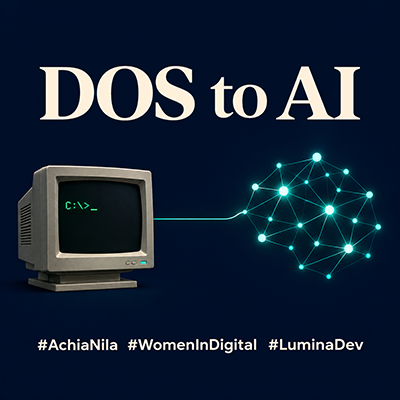
Overivew
This morning, I met with a business leader who had spent part of his career in banking and had also studied management information systems. We began with the practical questions: what system his business needs, how it might be developed, and where my company could help. It was a useful conversation about business needs and technology services.
Then he mentioned that he had worked with computers in the days of DOS, using the command line. The conversation changed. We started talking about how we had each learned technology, how computers were assembled, and how software and hardware worked together. He had worked with these systems before my time. I began my own hands-on computer experience when Pentium PCs were becoming familiar. Yet we recognised many of the same ideas in each other’s stories.
We talked about components, memory, graphics and sound cards, and the satisfaction of understanding what was inside a computer as well as what appeared on its screen. We talked about commands and programming, and how every generation meets technology through the tools available to it. What began as a discussion about a possible business system became a conversation about the long path from early personal computers to today’s AI tools.
I left thinking about how useful it is to talk across generations in technology. The meeting reminded me that a new interface can make technology feel entirely different, while many of the questions beneath it remain familiar: What problem are we solving? What information does the system need? How do its parts connect? Who can use it, and how do we know it is working well?
The language changes as technology moves forward
Every period of technology has its own vocabulary. In one conversation, we might talk about DOS commands, assembly language, processors, memory, databases and networks. In another, the words might be cloud platforms, APIs, machine learning, large language models and AI agents.
New terms matter because the tools and capabilities really do change. Today’s AI systems can work with language, images and other forms of information in ways that were out of reach for earlier generations of personal computers. Modern services also rely on advances in computing power, software, data infrastructure and networking. The change is more than a new package or a new marketing story.
At the same time, the basic discipline of building useful technology has not disappeared. A system still needs a purpose, a sound design, reliable information, appropriate security, and a way for people to use it. The components have changed dramatically, and many are now hidden behind friendly interfaces or provided as online services. But the work of understanding how those components fit together is still essential.
That is one reason the history matters. When you have seen technology develop through several stages, it becomes easier to recognise both what is genuinely new and what continues underneath. You can be excited about new capabilities without assuming that every new label means the foundations have been replaced.
From assembling PCs to designing systems
For those of us who began with relatively hands-on computers, learning often meant dealing directly with the parts. You might have to understand what a component did, whether it was compatible, and how it worked with the rest of the machine. You could see more of the relationship between hardware and software because you were closer to the machinery.
Today, much of that complexity is managed for us. A developer can use a cloud service rather than maintain a server room. A business can access powerful tools through a browser. A team can build on established platforms and focus its time on the problem it wants to solve. This is progress: abstraction makes technology more accessible and lets people build more quickly.
But abstraction can also make the foundations less visible. If a tool produces a polished answer, it is tempting to focus only on the result. Good technology work asks more: where did the information come from? How is it organised? What happens when it is wrong or incomplete? What should be automated, and what needs a person to review it? How will the solution fit the organisation’s existing processes?
A database is an important example. It is still a core part of many information systems, but AI is not simply another name for a database. A database stores and organises information. AI models identify patterns or generate outputs based on their design, training and input. AI services also depend on computing infrastructure, software, data flows and controls around their use. Understanding the distinctions helps a business choose the right tool instead of treating every problem as an AI problem.
What older and newer generations can learn from one another
People who worked through earlier stages of computing can bring a valuable view of how systems are put together and how quickly assumptions can become outdated. People entering the industry now bring fluency with tools and methods that previous generations did not have. Neither perspective is complete on its own.
The risk is that we mistake familiarity with a tool for understanding the whole system. A new generation may be highly skilled at using AI while having had fewer reasons to inspect the infrastructure beneath it. Someone with years of experience may understand the architecture and the history but need time to explore the newest platforms. These are opportunities for learning together, not reasons to dismiss one another.
I do not see today’s younger technologists as lacking ability or curiosity. Their starting point is simply different. Many have grown up with powerful tools already built into their daily lives. My generation remembers installing cards and components, seeing the machine’s limitations up close, and learning how software and hardware depended on each other. Both experiences can lead to strong technical thinking when we make space to share them.
The conversation this morning helped me see that what I had sometimes interpreted as a gap in understanding was partly a difference in vocabulary and experience. Once we began with our shared curiosity, we could connect the older language of computers with the newer language of AI. The technology had moved forward; the conversation did not have to stop at a generation boundary.
AI needs perspective as well as excitement
AI is opening valuable possibilities for businesses: helping staff find information, reducing repetitive work, supporting analysis, and creating new digital services. But a useful AI project begins with a real business need, not with the decision to add AI because it is fashionable.
Before choosing a tool, organisations should understand their processes and information. They should consider data quality, privacy, security, integration with existing systems, human oversight and how success will be measured. They should also decide where AI is appropriate and where a simpler, more predictable software feature would do the job better.
That is where experience across generations of technology can help. Someone who has seen systems evolve may ask how a new service connects to the systems already in place. Someone who works with current AI tools every day may see a faster way to prototype or improve a service. Bringing those perspectives together can lead to solutions that are both modern and grounded.
Building technology that connects business needs with the right tools
At my company, conversations like this are an important part of how we approach technology work. We start by listening to the business: what people need to do, what is slowing them down, and what outcome would make a genuine difference. From there, we can help shape the system, plan its architecture, develop or integrate software, and explore where data and AI can add value.
Our work draws on experience across digital products, business systems, integrations and technology-enabled services. That range matters because a strong solution is rarely just a screen or a feature. It needs to fit the way people work, connect reliably with the right information, and be practical to operate and improve.
We also believe in helping people understand the choices in front of them. Technology should not be a collection of impressive terms that business owners are expected to accept without explanation. Whether a business is considering a new management information system, improving an existing process, modernising a legacy platform or exploring AI, the conversation should make the options clear and connect them to business goals.
The next generation should know both the tool and the system
Technology will keep changing. Interfaces will become more natural, services will become more capable, and new generations will bring their own ways of working. The important thing is to stay curious about what is new while remembering to ask how it works, what it depends on, and who it serves.
My meeting today was a reminder that technology conversations can reveal unexpected common ground. A business discussion led to a conversation about DOS, PC components, software, databases and AI. We had learned at different points in the industry’s history, but we could still recognise the same underlying questions and share what we had learned.
Perhaps the generations are updating as much as the technology is. Each generation inherits a different set of tools, then learns to make those tools useful. The best progress happens when experience is passed on, new ideas are welcomed, and people build across those differences.
That is how we can move from DOS to AI without losing sight of the human understanding that makes technology work.
Recent Blogs
-
From DOS to AI: What Technology’s Generations Still Have in[..]
-
What it takes to make digital health work for everyone
-

Digital Innovation Challenge For Women, 2023
-

When Asking for Help Becomes a Challenge: Understanding the Hidden[..]
-

Interview with Lead Solution Architect Khawaja Anas Hasan
-

Empowering Change: Women in Digital Launches Cybersecurity Awareness Through Community[..]
-

Gender Lens Investment
-

Online Violence Against Women In Bangladesh And Initiatives
-

Cyber Security Awareness Program, September 2022
-

Winners of UNDP Hackathon receiving prize money from Women in[..]